Question 1: If working class women had received more attention from the media and made their struggle known, how do you think this would have impacted the feminist movement? Do you think this would have allowed women to gain equality in areas such as household duties and wage? I think that the feminist movement is still very young and I just do not know if a lot more media attention will make it a positive, or if it will make the movement go back to steps. It would obviously bring more attention to the matter in general, whether good or bad. I think that more media might also change the movement; I mean we can look at how Occupy Wall Street changed completely once the media got fully involved. I do think that maybe this would have allowed women more equality, or it would just piss people off more and oppress women even worse. I think wages and household duties are kind of two different areas. Household duties are a more personal topic that can be discussed one on one and it is not every ones business. What if I like to clean the kitchen, but I am a feminist and now these feminists think I shouldn’t clean the kitchen? I think that wages in the work place however are a somewhat public matter. If a women (or anyone) is working to the best of their ability and going above and beyond there is no reason they should not deserve an equal pay to their counterparts.
Question 2: Even though the global feminist movement has traditionally been headed by white, privileged women, it is important to note that women of the United States have helped lower rates of sexism and sexual exploitations in some nations. Through enforcing “white supremacist capitalist patriarchy” many women in the feminist movement were silenced. What types of women do you believe were silenced? If these silenced members’ opinions were voiced what effect do you think they would have on nations struggling with sexism, sexual exploitation, and oppression? Would this change the global interactions we see today, or would the world function similarly? Women that I believe were silenced would be the women that can not identify with the white supremacist capitalist patriarchy type. I would even argue that women that are happy in their what many feminists see as oppression type lives. I think that if these women voiced their own opinion it would make a lot more people want to join the movement and even maybe change a lot of the stereotypes of feminism. I think the world would be completely different maybe even more understanding and peace with people.
Do you think when women stay home and do the household work, do you think they get depressed because they aren’t making any money to help out in the family?
I do not think that stay at home moms look at it from that aspect. I think they look at it more that they are working. Cleaning and maintaining a household is a large responsibility. I think that if times get hard then a women might start to feel a little depressed because she is not bringing in any money. However I also think that women are constantly reminded that "there place is in the kitchen" I think that if a women was depressed because she was not making "Paper money" she would change what she is doing and start making the cash. I think more women are completely content with staying at home and doing housework then we give them credit for.
If working class women had received more attention from the media and made their struggle known, how do you think this would have impacted the feminist movement? Do you think this would have allowed women to gain equality in areas such as household duties and wage?
Had working and lower class women been given more attention, I think it would have exposed the hypocrisy and double-standard present in the movement. Although women were fighting for equality, the internal representation provided across different identities such as class and race (as discussed in chapter 10), were severely distorted and unfair. As hooks discusses, challenging the oppression of difference and confronting stagnant views associated with "second-class" citizens provided for a more realistic, honest sisterhood among feminists. No doubt this would have ushered in a far less ignorant perspective in terms of the responsibilities and rights of women both within and outside of the household.
Even though the global feminist movement has traditionally been headed by white, privileged women, it is important to note that women of the United States have helped lower rates of sexism and sexual exploitations in some nations. Through enforcing “white supremacist capitalist patriarchy” many women in the feminist movement were silenced. What types of women do you believe were silenced? If these silenced members’ opinions were voiced what effect do you think they would have on nations struggling with sexism, sexual exploitation, and oppression? Would this change the global interactions we see today, or would the world function similarly?
I think the groups of women silenced are any of those that don't fall into the upper-class, white, empowered identity. I feel many of these groups would bring social justice given the chance, but its not as simple as telling everyone sexual exploitation is immoral. Many of the Eastern European countries that highlight this issue simply don't have the cultural perspective and economic infrastructure necessary to integrate women into the workforce in a way that would impact the problem. I think the issue also arises from the demand on these women and the sex itself; so a reevaluation in the way people view the act and role of sex should be brought to light. In contrast, many countries don't posses the same cultural ideology as we do, and may not have such a prevailing patriarchal perspective. Therefore women don't feel the need to isolate themselves from men or form a "sisterhood" so much as simply a collective acceptance as human beings. Similarly, men in those cultures don't feel the need to undermine, sexualize, or humiliate women. These individuals may already feel like they posses equality and a satisfying family dynamic, and may not want white, false-feminist views of "anti-men" imposed on their culture. I don't believe the change would bring further globalization or anything, but I feel it would impact the respective areas pursuant to whatever change took place.
Do you think when women stay home and do the household work, do you think they get depressed because they aren’t making any money to help out in the family?
No, I don't believe women get depressed focusing on household work or being a "stay-at-home mom". Going back to one of my previous post, I'd say "if you're happy, you're happy". Women certainly don't need to conform to a nuclear family ideal where their only responsibility is to please their husbands and tend to the home. However they have no responsibility to themselves as a result of a post-feminist time period to pursue a life-consuming career either. Wether a woman feels the need to stay at home, or dominate a career path, she should do it unapologetically. The following clip helps to illustrate my point.
Chapter 7: Feminist Class Struggle Chapter 7 discusses issues of class in the feminist movement. hooks discusses the role of higher class white women in the feminist movement. Because they were the group of women who received public attention, when they gained equal access to class power with their male counterparts, the issue of class struggle was no longer as important in the feminist movement. hooks highlights the differences between the feminist issues of the higher class women and the lower class women.
Question 1: hooks states, “…as feminist movement progressed and privileged groups of well-educated white women began to achieve equal access to class power with their male counterparts, feminist class struggle was no longer deemed important” (hooks, 2000, p. 37) and “From the onset of the movement women from privileged classes were able to make their concerns “the” issues that should be focused on in part because they were the group of women who received public attention” (hooks, 2000, p.37).
If working class women had received more attention from the media and made their struggle known, how do you think this would have impacted the feminist movement? Do you think this would have allowed women to gain equality in areas such as household duties and wage?
Chapter 8: Global Feminism (p. 44) Chapter 8 discusses global feminism through exposing the flaws in the spread of Western feminism. hooks presents the idea that Western women believe they “...have the right to lead feminist movements and set feminist agendas for all the other women in the world, particularly women in third world countries” (hooks, 2000, p. 45). However, by imposing their ways on other nations, these feminist women are really only projecting their social status and race onto others. The movement is led by predominately white, upper-class women, and their actions and beliefs support parasitic class relations instead of those of race, nation and gender (hooks, 2000, p. 44).
This clip of the Ali G Show starting at 1:30 depicts a humorous spin on the serious issue of sexual exploitation of many women across the globe as a means of economic survival. Although this is a joke to us in America, it is important to remember this is real life for some women in other nations.
Question 2: Even though the global feminist movement has traditionally been headed by white, privileged women, it is important to note that women of the United States have helped lower rates of sexism and sexual exploitations in some nations. Through enforcing “white supremacist capitalist patriarchy” many women in the feminist movement were silenced. What types of women do you believe were silenced? If these silenced members’ opinions were voiced what effect do you think they would have on nations struggling with sexism, sexual exploitation, and oppression? Would this change the global interactions we see today, or would the world function similarly?
Chapter 9: Women at Work In this chapter it explains how women don’t get paid the same and still out there in the workforce. Women have been in the workforce for a long time now whether we are paid well or receive low wages many women have not found world to be as meaningful as feminist utopian visions suggested. When women work to make money to consume more rather than to enhance the quality of out lives on all levels work does not lead to economic self-sufficiency.
Question 3: In bell hooks book she says “in many college classrooms today students both female and male will argue that feminist movement is no longer relevant since women now have equality.”
Do you think when women stay home and do the household work, do you think they get depressed because they aren’t making any money to help out in the family?
Question 1: Which clip do you think portrays each
respective time? Do you think there is a racial bias in either of these
representations and why? What motives do you feel white women would have in practicing
discretion with respect to race during these liberating times?
Understandably,
most of the responses were in congruence with each other. All of the responses
easily labeled the clips to their respective times, and went on to identify
racial bias within both, often in the form of the suppression of colored women.
Many of you aligned yourself with Hooks’ suggested motives, identifying
attitudes toward race and superiority typical of the time period and the fear
of “asking too much” as reasons for discrimination and ignorance by white
women. One comment I found insightful referred to the hierocracy of these empty
motives stating, “They lacked substance because they were not being true to
themselves and the movement they believed in due to their denial.”
Question 2: Do you feel this "evolution of
perspective" is paralleled in our generation today with respect to the
many issues of humanism such as sexism, racism, ageism, violence etc.? What
external factors perpetuate this change? Do you believe this to be positive or
negative?
The
majority of responses upheld the idea that we as an incoming generation do hold
perspectives that challenge those that preceded us. To what degree however,
varied. Many of you acknowledged that we’ve come a long way in mitigating
issues of racism and sexism, but some still claim that the issues are just as
prevalent today as in the past; although they may not be as authoritative or
consciously accepted/acknowledged. Complimenting this was a statement that
talked about how racism today is evasive and ignored, rather than strict and
obvious. Some cited the lack of formal oppression that exists today in
comparison to the past and the spread of ethical awareness and knowledge as
factors that perpetuate these perspectives. The majority of you believed this
phenomenon to be a positive transition as one person stated, “Being aware of
how that is a wrong, we can better communicate with others, and with ourselves,
to become better people.” However, in contrast, not necessarily realistic
stating that “These issues are part of mankind and will never go away
because I don’t think we can function as a society without their presence. Can
we?”
Chapter 11
Question 1: What do you think could be some of the
underlying causes of this violence? Hooks also notes that much of the public
refuses to link the violence to patriarchal thinking or male domination, why do
you think this is?
Most
people supported and cited that one major underlying cause for violence was
insubordination both within and outside the home or family life. One statement
saying, “Some underlying causes of patriarchal violence … [is] because they
have no power outside of the home.” supported this. Feelings of low self-esteem
and patronizing attitudes foster a distorted self-image and create hostility
aimed at those who we view below us. Other contributing comments identified the
way in which we attach violence to notions of power, masculinity, strength, and
superiority. Another common approach to explaining violence concerned the way
in which men and women are conditioned in childhood experiences with regard to
the acceptance of violence.
One
argument that explained why we refuse to identify the link between violence and
patriarchal thinking was the autonomous nature of our country, and how we focus
on taking care of ourselves, instead of looking at underlying issues and the
root cause of problems. In a similar light, others suggested that individuals
try to reason or attribute the violence to causes that conflict less with their
hegemonic ideals stating, “…[they try to] find easier and more
poignant examples of what is causing violence, and not point the
finger at the system itself.”
Question 2: After watching this video and thinking of some
responses on your own, how do you think domestic violence between spouses and
children can be related? Also, after the video, how do you think this issue of
the two forms of violence being closely related each other can be brought more
to light so that the issue can be more of a topic to be worked on being
resolved? What steps do you think need to be taken to resolve this form of
violence? (Sorry the clip is not in English, but the point still gets across.)
As to how
the occurrence of violence is related, many people cited the social learning theory, or how children
learn the cycle of violence by observing it from their parents. Also these
examples of violence are often triggered by similar emotions such as
resentment, humility, anger, and aggression; held between both the spouses or
the parents and children in question. Suggestions for combating the issue
included educating both children and adults on how to reasonably and
respectfully communicate emotions, and spreading awareness of the issue through
educational institutions and tools with high exposure like the media and
Internet.
1) Which clip do you think portrays each respective time? Do you think there is a racial bias in either of these representations and why? What motives do you feel white women would have in practicing discretion with respect to race during these liberating times?
In my opinion, the first clip represents the early stages of women's suffrage, and that the second clip focuses on the civil rights movement. Although the clips are primarily about two different movements, fighting for women's rights is seen in both. Although subtle, I definitely think the first clip does have a racial bias. The focus on women's suffrage was about white, upper class, educated women. Nothing is mentioned about African American's in this clip. Personally, I think the biggest motive in white women practicing discretion with respect to race was simply because they didn't want to ask too much in such a short time. Society doesn't take well to change. Because of this, every change made has to take baby steps. A baby step would be for women to vote. Too far and too fast for society would be rights for women, both white and African American women.
2) Do you feel this "evolution of perspective" is paralleled in our generation today with respect to the many issues of humanism such as sexism, racism, agism, violence etc? What external factors perpetuate this change? Do you believe this to be positive or negative?
I apologize if I sound unintelligent, but I'm not sure what this question is asking, but I will answer it with an answer about what I think it is asking. I do think perspective has changed four our generation in regards to issues of humanism. In the last 50 years women's roles and expectations in society have changed immensely. Although we still have an agist society, recent research is showing that being elderly does not make you a lesser person. Past scholarly understanding was very different.
Ch11 1) What do you think could be some of the underlying causes of this violence? Hooks also notes that much of the public refuses to link the violence to patriarchal thinking or male domination, why do you think this is?
I think one of the biggest underlying causes of domestic violence is how men are portrayed in the media. Men in the media are violent and controlling. This violence and control is absolutely linked to male domination. These ideals are taught starting in childhood, as seen in Disney films. This concept is explained in the following clip:
Although this doesn't show domestic violence in particular, it is still putting the idea of violence and dominance being expected from men. Because these ideas are taught from such an early age, they are seen as normal. Because they are seen as normal, the public refuses to link violence to male domination.
The following clip shows more male violence portrayed in the media, and especially focuses on normalizing male violence against women (My apologies for only posting the link. I couldn't find the video when I tried to insert it into the blog.):
http://www.youtube.com/watch?v=elbWcsM7eoA
After watching this video and thinking of some responses on your own, how do you think domestic violence between spouses and children can be related? Also, after the video, how do you think this issue of the two forms of violence being closely related each other can be brought more to light so that the issue can be more of a topic to be worked on being resolved? What steps do you think need to be taken to resolve this form of violence?
After watching that intense video and from my personal opinion, I absolutely think that spouse violence and violence towards children are absolutely related. From a psychological standpoint (not that I'm qualified), the offender is violent towards the spouse and children in order to have a sense of control. The idea that there is relation between these forms of violence needs to be heard, whether it through the news, through movies, or music, simply getting the ideas heard is the best way to start to find a resolution for this. More resources for safety for the victims needs to be available because partners often stay with the abuser because they are frightened for their life. Abusers that attempt to leave are often murdered or hurt worse by the abuser, so many feel that it is better to not risk their life.
I have watched the movie Iron Jawed Angels in another course in college and it is a depiction of the women’s suffragist movement as done by white women. The focus on white women was noted by viewers as seen in a comment on the clip stating “women of color were actively excluded in first wave feminism, and the story of black suffragists is all but absent from this film”. The Help clip is centered more on early struggles of the civil rights movement when black women were still not viewed as equals. One can argue that even today black women are not portrayed as equals. The media has helped create a culture in which members of our society believe black women act more like the characters in the first clip I have included rather than the second. Evolution of perspective can be seen in our generation today in focusing on current social issues. Each generation hears what previous ones have said and done and then alters these messages. Currently, our generation is challenging many of these long-lived perspective issues, allowing people to speak more freely on their stances. This can be openly seen through generation changes in voting trends. Younger generations have become increasingly more democratic, showing a larger interest in promoting for all individuals no matter what race, ethnicity, sex, gender, or sexual orientation. I think this is a positive change for it is important for individuals to recognize not everyone is the same but that does not mean they deserve differential treatment. Male aggression is something that is brushed off far too frequently in our society. Domestic violence has many triggers but the aim to maintain a patriarchical household is often the primary motivator. Today, men are often responsible for items which at one time were considered strictly feminine tasks. These tasks include washing dishes, doing laundry, and caring for children. Although in some households the stereotypical gender roles hold true, more often than not there is some type of fusion within a household. Pent up frustration with their actual life versus the one society envisions them to have can be a motivator for this male domination. I think this is often overlooked in society because of the negative connotations that come along with being labeled a feminine male.
Ch 10 Question 1) I watched this film in one of my classes years ago and it is absolutely chilling what some of these women went through to fight for a right that I take for granted and only exercise every four years. I especially remember the part when they decide to protest in front of the White House and people say that they can't "picket a wartime president". This is such an interesting statement to me because I think this sentiment remains in a variety of settings. Like don't criticize a system that is working for you in so many ways just because it is not working in one way. Criticism and feedback should always be allowed in order for voices to be heard and needs met.
The second clip definitely refers to the beginning of the civil rights movement, which also began which voices being heard. This movie was interesting because it showed the wide range of attitudes of both white and black women during that time period. There were some women who strictly abided by the rules between white women and their black help and other women who did not care for the rules, such as eating separately and no hugging. And then there were the younger women, such as the main character, who regarded the help as family because they had raised them from the time they were babies and played a motherly role in their lives. To me this reflects the same thing today that there is a wide variety of opinions about the race issue and women's rights, but in inverse proportions.
This made me think of a clip in the movie A League of Their Own. This has been one of my favorite movies since I was quite young, probably 9 years old. My parents strictly censored what I was allowed to watch, so it was exciting to be able to see a movie with famous actresses. And it is such an empowering movie for women in so many ways. One of my favorite aspects is that the movie did not put in any unnecessary romance or affairs between the characters and coach or other males. I think that today, unfortunately, this would have been "Hollywoodized" in this way and totally ruined. Anyway, the clip I am looking for is impossible to find anywhere so I will describe it. Near the end of the film in a brief moment there is a nod to the fact that yes this is a film about a time that was empowering to women but that it was for white women. In the scene the women are practicing and the baseball goes out of field. A black woman picks it up and instead of throwing it to one of the women closer to her throws it farther to another woman. She throws it so far and hard that the woman who catches it takes off her glove and shakes her hand. I remember the very first time I saw this scene and my dad explaining the significance of it. It is a powerful moment.
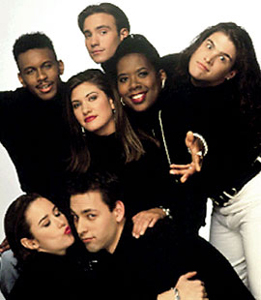
The Real World 1992
Ch 10 Question 2) Evolution of perspective is definitely in our generation in many ways and levels. For example, in one of my classes last semester we talked about reality shows like Real World and Road Rules that purposely mixed up people from differently backgrounds and watched them live and grow together. Our discussion was about how it seemed that the early seasons of this show focused on picking people of different races and geographical backgrounds and later seasons tend to mix up the group based on different sexual orientations. I think this is because for a large part (not all) of our generation, race is a non-issue. Now we can tackle prejudice against sexual orientation in the same manner and hopefully for the next generation (or sooner) that will become a non-issue and will move on to something else. To me this generational change is one of the major factors that comes into play in social movements like these, although there are always exceptions in both the older and younger generations.
Ch 11 Question 1) This chapter riled me up a bit because it deviated so much from the initial messages about feminism being about women AND men. There was no mention of domestic violence against men in both heterosexual and homosexual relationships. This is such an overlooked area because violence is something people do not want to talk about, let alone the victimization of men. Even in our media illustration today (no offense to the presenter, she did a great job) there was no mention of men being victims of sexual violence! And furthermore I did not like the wording in the bell hooks book about linking domestic violence to patriarchal thinking or male domination. Does "male domination" explain the same sex violence between two women that bell hooks mentions? This just makes me mad even writing this.
The following is a clip from the show What Would You Do? that has actors in real life situations to gauge what the public's reaction is. I actually do not like this show because I believe that people have intuition about when to intervene/call the police and that having actors affects people's intuition. BUT, with that said, this clip makes some very good points and made me think.
Some of the underlying causes I can see are a variety of things. I know some men who absolutely hate the legal system because they feel it favors women: she'll get the children, she'll get awarded child support, the state can garnish wages for child support, etc. I know men who hate women, think they are all cheaters and will just live off of child support while he works himself to the bone the rest of his life, lives in poverty and occasionally sees his children. Yes, this happens in some cases. But I think it is a minority of cases.
Another underlying cause I could see is what men experience on the job. I can only speak from my experience, which was full-time work in a factory. I saw the amount of crap that the technicians and mechanics (which were 99% male) had to put up with on a daily basis. It is hard to define this "crap" because it occurred all the time and in so many ways. When I think about it, it boiled down to 1) having very little decision-making power in the workplace 2) being highly underappreciated 3) being treated like one of many and not necessarily a unique individual with unique contributions. We were all treated like this, but I think for the men in the technical positions it was an emasculating experience. I can see how someone in this day in and day out for their 20, 30, 40 years of work could take out their frustration at home on their partner, although I am of course not excusing that. Of course there are productive ways to act out frustration like going to the gym and punching a punching bag, not a person, joining a men's group with a strong foundation like in a church or AA. There need to be more resources like this where men can mentor each other and have a conversational outlet. Of course, I am saying this as a woman and this is what I see as a solution, however, it may be different from a man's perspective. And I just realized that I am talking about men as the abusers, the very thing that made me so mad in my previous paragraph. Accidental hypocrisy induced by a lifetime of patriarchal societal thinking.
Ch 11 Question 2) I think domestic violence between spouses definitely affects the children in many ways. I had a previous boyfriend who told me horrifying stories of the domestic abuse between his mom and her succession of boyfriends throughout his entire childhood. It was sick how much it affected his life. He said he and his sister would get very little sleep because his mom and current boyfriend would scream and yell at each other all night, with violence toward his mom. Then he would be tired all day at school and not do well academically at all. He ended up dropping out of high school. I know that there are other factors that contribute to this, but it sickens me to think that this person's entire life was affected by this in this way. He had a right to an education and it was taken away by mostly listening to abuse in the home. He witnessed it and was involved on some occasions, but the worst of the effect simply came from hearing it while trying to sleep. This just boggles my mind that people can do this! And furthermore, his sister has only been in relationships with men who beat the crap out of her. The person that she considers "the one" for her beats her up regularly, has a baby with her, is in prison for three years, and she still visits him and wants him in her life! The whole family was scared of him and when he would get out of prison. It is just so messed up that entire families are affected by domestic violence for generations. I am just so outraged even writing this!
At a very young age from the time I was born until I was about 3 years old, my mom had boyfriends/husband who were abusers (none were my father). This is really hard for me to talk/write about because it stopped after that and I don't want to put my mom in a negative light. I was so young that I, of course, don't have many memories of that time. The hard part is that the memories I do have are painful, bring tears to my eyes, a knot in my throat and a pit in my stomach. It is true that the younger the child, the more of an effect this has on shaping who they are. I did not learn any of the "lessons" in the above video clip, which I have also heard in other classes. The lessons are that children will learn abuse is normal and learn to be aggressive. But there is something else that children can learn: fear. Specifically fear of victimization. I definitely learned fear and have had a very fear-based mentality that I have struggled with for my entire life. It has only been recently that I have overcome a lot of this and that was only through years and years of intrapersonal work, counseling and especially spiritual work.
So what steps do we take to stop these effects of domestic violence on children? I don't know where this starts. We can make it part of the legal system with consequences to engage in domestic violence in front of children. I just learned in my Human Sexuality class that this can legally be reported as child abuse in the state of NE and some other states. This is a start. I think another major factor is people speaking out about their experiences as children. We hear so much about children who grow up in abusive households who become abusers. But there are NUMEROUS individuals who grew up in households with domestic abuse who have NEVER been abusers. Many have never spoken about their experiences, wishing to bury the pain. But if people who have gone through these experiences can speak out about their pain, it can help children who are in these situations.